
History of the Shabe

HISTORY OF THE SHABE ETHNICITY
Shabè represents an advanced march of Yoruba civilization towards the west. The Oba, the King on the throne, is consecrated to Jabata and wearing the adé (crown) of Odùduwa, celestial god who is said to be the founder of Ifè and the ancestor of all Yoruba kings.
The old story of Shabè is part of the period that can be called the Yoruba cycle; more recent times correspond to the Boko cycle, determined by the Boko-Bariba migration, with other cultural contributions.
During the 16th and 17th centuries, population movements occurred in Borgou, which were to have repercussions in the Shabè world.
Following the war and invasion of the Nupes, the large Yoruba city of Oyo was abandoned by its inhabitants who, with their king, sought refuge westward, in Borgou. After four or five generations, the refugees returned to Oyo.
However, a few groups of these Yoruba refugees had spread out, continuing their march further west: arriving near the Okpara, they crossed the river near Okuta/Ilesha. From there, the migrants separated into two fractions, some heading north (Niger, Malanville), while the others, heading south, would eventually arrive in Shabè, after a more or less extended in Bariba country.
The great lineage of the Omo Baba Guidaï would end up imposing its political pre-eminence, founding kabwá first, then inaugurating a new royal dynasty which, despite wars and interregnums, was to continue until the present day.
Considered one of the seven “primitive” Yoruba kingdoms, Shabè would subsequently receive an important human and cultural contribution from Boko-Bariba. This double influence now constitutes the fundamental feature of the history of the Shabè ethnic group, and which, in varying proportions, characterizes the language, the organization of kinship and the family, the social and political institutions and finally religious life.
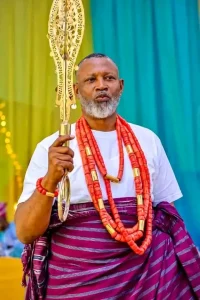
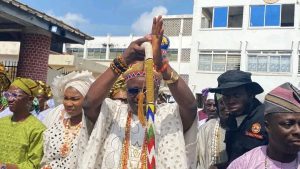
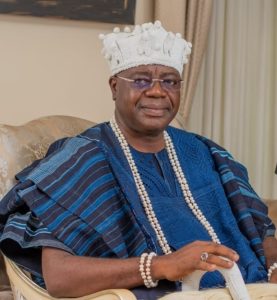
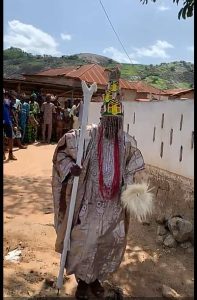
Kabiyési Oba Adetutu Akinmu, Onishabè wearing the adé of Odùduwa during the annual ODON FIDITI 12th edition 2023.
This Adé was ritually given to Onishabè in August 2008 by His Imperial Majesty OBA OKUNADE SIJUWADE THE OONI OF IFE (1980 -2015)