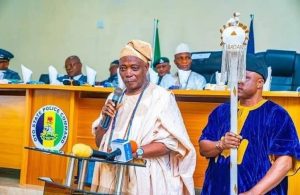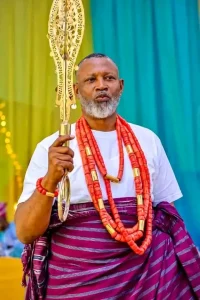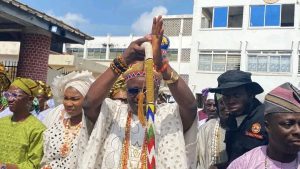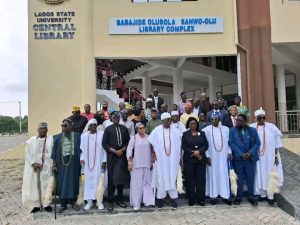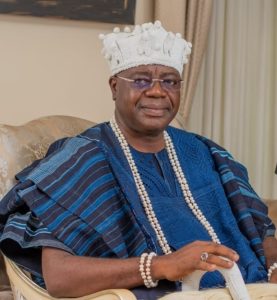

His Royal Majesty, Adedokun Abolarin, Aroyinkeye I
Soon after the turn of the millennium, the current Orangun of Oke-Ila Orangun in Ifedayo Local Government area of Osun State, Oba Adedokun Abolarin was installed on December 8, 2006. Oba Adedokun Abolarin is from the Obasolo Ruling House, one of the three ruling houses among which the title rotates in Oke-Ila Orangun.
The new Òràngún of Òkè-Ìlá, Oba Adedokun Abolarin is a highly educated professional, holding a law degree, after a master’s degree in International Relations, following a bachelor’s degree in Political Science, all from Obafemi Awolowo University (formerly University of Ife). Until his installation, the new Òràngún of Òkè-Ìlá, Oba Adedokun Abolarin, a professional lawyer licensed to practice law in the Supreme Court of Nigeria, was the principal partner of Dokun Abolarin & Co., a firm of Solicitors and Legal Consultants, which had served as Company Secretary to various corporations among whom are Tell Publications (Publishers of Tell Magazine), Pacific Holdings, Peachtree Communications Ltd, Sportsmark International and Springtime Development Foundation.
Oba Adedokun Abolarin is an academic authority on Nigerian government and politics having researched and written on the period from the 1914 amalgamation to recent times, in which he evaluated component elements of federal, regional/state, and local government administration, analyzed Nigerian foreign policy, political parties and pressure groups.
As is traditional among the Yoruba for a new king or monarch, Oba Adedokun Abolarin chose at his installation the “reign name” Aroyinkeye I, translating as “one who finds honey to tend the title”. Citizens of this ancient Igbomina-Yoruba kingdom across Nigeria, and especially Europe and the Americas often express their thrill and excitement at the prospect of the development which the well-educated king promises for the city and its satellite towns.
Immigrant dynasties Edit
Oke-Ila Orangun has a couple of historical minor kings (or royals) under the Orangun of Oke-Ila. These are kings of the wards/quarters (townships or sub-towns) of Oke-Ila that consolidated as immigrant communities in the last five centuries of Oke-Ila history, as early as at its foundation subsequent to the exodus from Ila-Yara. These Realm/Ward/Township Royalties retain varying degrees of royal privileges and perform their ancient royal traditions, which in Yoruba tradition is to be exercised in their clan’s territory within the consolidated kingdom. However overriding royal power is retained over the entire kingdom by the Orangun who is paramount king over the entire kingdom.
The “Ward/Township King” of the Ìsèdó-Oke group is titled Ọba’lúmọ. The Ìsèdó-Oke group was the earliest (and possibly the largest single group) to join with the then Orangun Apakiimo to found his new kingdom (now called Oke-Ila) towards the end of the 15th century, about 1490 AD. The “Realm/Ward/Township royal” of the Iranyin group is titled “Obanla” but the position has not been filled in living memory. The role of the Obanla seems to have been taken up by (or given to) the Obajoko in the modern Royal Council of the Oke-Ila Orangun kingdom. The Iranyin group seem to be a more recent “consolidant” with Orangun’s kingdom at Oke-Ila relative to the Isedo group.
The “Crowned Heads/Crownly Heads” Caucus & incumbents Edit
In the traditional royal council of Oke-Ila, both “ward/township kings” are constituted with other royal clans – the heads of the Orangun ruling houses, into the Oriade (“Crowned Heads/Crownly Heads”) – a “royal heritage caucus” of the “senate” or superior royal council.
“Minor kings” (of ancient immigrant wards/quarters) Edit
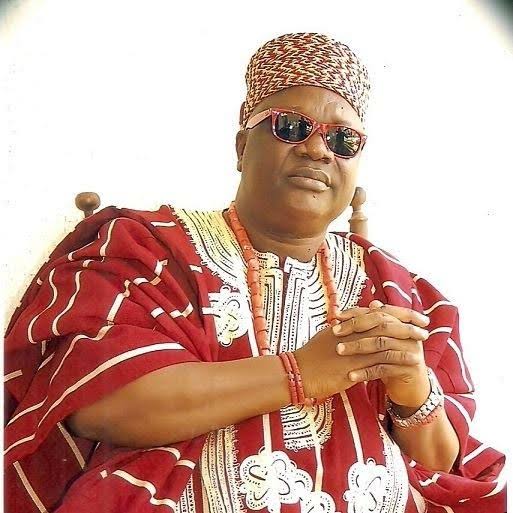
The current Ọba’lúmọ̀ of Ìsèdó-Oke ward/township is His Royal Highness, Dr. Olúfẹ́mi Ọládàpọ̀ Babalọlá. Oral historians state that Iranyin ward/township also has a royal title called “Obanla” but the highest ranking title-holder from the Iranyin ward is the Obajoko of Iranyin ward/township. (The “Obanla” title also exists in Ila Orangun). It is not clear if any other clan in Oke-Ila has maintained substantial relics of royal privileges. It seems that such clans would presumably be represented in the “Arewa” senate, except if removed or proscribed for some reason in historical times (before the British colonial period). However, a few other clans have maintained symbolic noble privileges.
Orangun Dynasty – ruling house heads Edit
The heads of the Orangun ruling houses that are part of this “royal heritage caucus” of the “senate of ten” – (Arewa) are His Royal Highness, The Obasolo: Prince Adeoti Adesoji and His Royal Highness, The Elemoogun: Prince Adeyemi Olatunde.
Educational & religious institutions Edit
Òkè-Ìlá Òràngún has several primary and secondary schools most of which are privately owned. The premier secondary institution is the Òkè-Ìlá Òràngún Grammar School. The first primary schools are the Seventh-day Adventist Day School situated at the foot of a peak on the west edge of the city, and the Baptist Day School situated at the foot of the mountain on which the old city is located.
The Seventh-day Adventist Church of Nigeria and the Baptist Church (Nigerian Baptist Convention) were the first churches to be established in the city. Both denominations now have multiple churches in the city. Other churches include the Church of Nigeria (Anglican Communion), the Apostolic Church, the Christ Apostolic Church, the Cherubim & Seraphim Church, the Aladura Church of the Lord, and many others. The city has a central masjid and other minor mosques where Muslims worship. The percentage of adherents of traditional religions is decreasing but there are worshipers of the major Yoruba traditional religions like Sango, Ogun, and Egungun.
Òkè-Ìlá Òràngún’s town hall adjoins the palace of the Òràngún, the paramount king of the kingdom. It is named Apakiimo Town Hall, in honor of the last king of the unified kingdom who led the final exodus from Ila-Yara, capital city of the original unified kingdom that subsequently became the sister kingdoms of Òkè-Ìlá Òràngún and Ìlá Òràngún.