
His Majesty Salman bin Abdulaziz bin Abdul Rahman bin Faisal bin Turki bin Abdullah bin Mohammed bin Saud.
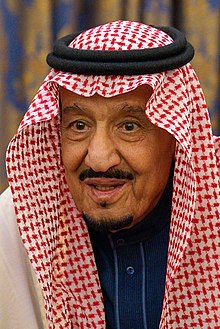
Salman bin Abdulaziz bin Abdul Rahman bin Faisal bin Turki bin Abdullah bin Mohammed bin Saud.
The kings since Ibn Saud’s death have all been his sons, and all likely immediate successors to the reigning King Salman will be from among his progeny. Sons of Ibn Saud are considered to have primary claim on the throne of Saudi Arabia. This makes the Saudi monarchy quite distinct from Western monarchies, which usually feature large, clearly defined royal families and orders of succession, and use the absolute primogeniture system of succession. Muhammad bin Nayef was the first grandson of Ibn Saud to be in the line of succession before being deposed from the position of Crown Prince by a royal decree in 2017.
The King of Saudi Arabia is Saudi Arabia’s absolute monarch who serves as head of state and head of government. He is the head of the Saudi royal family, the House of Saud. The King is called the “Custodian of the Two Holy Mosques” (خادم الحرمين الشريفين), a title that signifies Saudi Arabia’s jurisdiction over the mosques of Masjid al Haram in Mecca and Al-Masjid an-Nabawi in Medina, and replaced “His Majesty” in 1986.
Salman was born on 31 December 1935, and is reported to be the 25th son of Ibn Saud, the first monarch and founder of Saudi Arabia.[1] Salman and his six full brothers make up the Sudairi Seven.[2][3] He was raised in the Murabba Palace.[4]
Salman received his early education at the Princes’ School[5] in the capital city of Riyadh, a school established by Ibn Saud specifically to provide education for his children.[6] He studied religion and modern science.