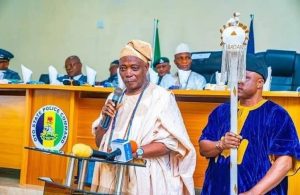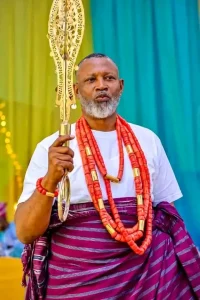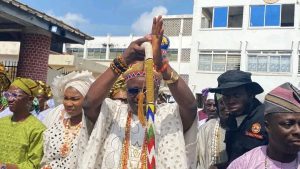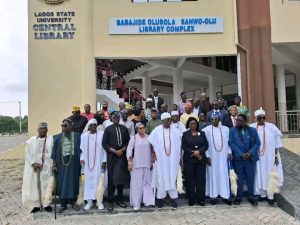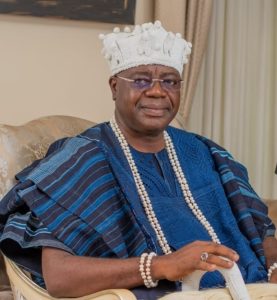

His Royal Majesty, Oba Saliu Adetunji (bornAugust 26, 1928) is a Nigerian monarch who currently sits as the 41st Olubadan of Ibadan following his coronation on March 4, 2016.
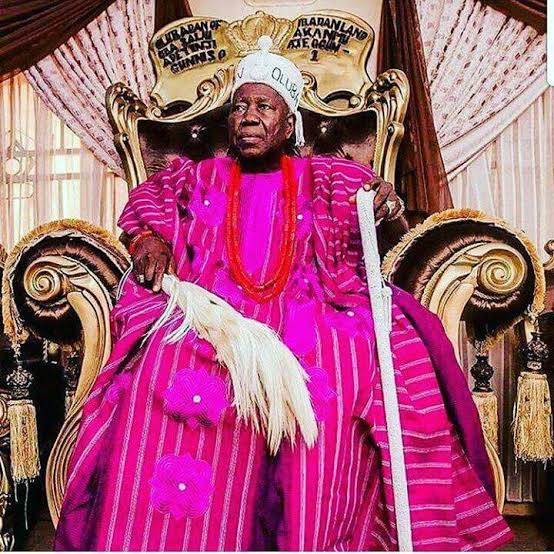
Ibadan, coined from the phrase “Eba Odan”,[4] which literally means ‘by the edge of the plains’, came into existence in 1829, during a period of turmoil that characterized Yorubaland at the time.[5] It was in this period that many old Yoruba cities such as old Oyo (Oyo ile), Ijaye and Owu disappeared, and newer ones such as Abeokuta, new Oyo (Oyo atiba) and Ibadan sprang up to replace them.[6] According to local historians, Lagelu founded the city, and was initially intended to be a war camp for warriors coming from Oyo, Ife and Ijebu.[7] As a forest site containing several ranges of hills, varying in elevation from 160 to 275 metres, the location of the camp offered strategic defence opportunities. Moreover, its location at the fringe of the forest (from which the city got its name) promoted its emergence as a marketing centre for traders and goods from both the forest and grassland areas.
The church and mission in Ibadan
In 1852 the Church Missionary Society sent David and Anna Hinderer to found a mission. They decided to build the mission and a church in Ibadan when they arrived in 1853.[8]
Ibadan thus had initially begun as a military state and remained so until the last decade of the 19th century. The city-state also succeeded in building a large empire from the 1860s to the 1890s which extended over much of northern and eastern Yorubaland. It was appropriately nicknamed idi Ibon or “gun base”, because of its unique military character.[9]
Unlike other Yoruba cities with traditional kingship institutions however, In Ibadan, the warrior class became the rulers of the city as well as the most important economic group.
Ibadan grew into an impressive and sprawling urban center so much that by the end of 1829, Ibadan dominated the Yorùbá region militarily, politically and economically. The military sanctuary expanded even further when refugees began arriving in large numbers from northern Oyo following raids by Fulani warriors. After losing the northern portion of their region to the marauding Fulanis, many Oyo indigenes retreated deeper into the Ibadan environs. The Fulani Caliphate attempted to expand further into the southern region of modern-day Nigeria, but was decisively defeated by the armies of Ibadan in 1840, which eventually halted their progress. The colonial period reinforced the position of the city in the Yoruba urban network. After a small boom in rubber business (1901-1913), cocoa became the main produce of the region and attracted European and Levantine firms, as well as southern and northern traders from Lagos, Ijebu-Ode and Kano among others. The city became a major point of bulk trade. Its central location and accessibility from the capital city of Lagos were major considerations in the choice of Ibadan as the headquarters of the Western Provinces (1939) which ranged from the northernmost areas of Oyo State to Ekeremor, Bomadi and Patani, which were regions transferred from the old Delta province in the Old Western region and later Mid-west to the old Rivers state and later Bayelsa, in the redistricting of Nigeria carried out by the Yakubu Gowon administration shortly before the Nigerian civil war
Colonial Ibadan Edit
In 1893, Ibadan area became a British Protectorate after a treaty signed by Fijabi, the Baale of Ibadan with the British acting Governor of Lagos Colony, George C. Denton on 15 August.[10] By then, the population had swelled to 120,000. The British developed the new colony to facilitate their commercial activities in the area, and Ibadan shortly grew into the major trading center that it is today.
Ruling Lines Edit
There are two ruling lines to the throne of Olubadan, Egbe Agba (civil) and Balogun (military), from where Olubadans are appointed on rotational basis to occupy the stool on the death of a monarch. The next to Olubadan and most senior on both lines are the Otun Olubadan and Balogun, who under the Western Nigeria Law are recognised as second class traditional rulers and who are included on the Nigerian equivalent of a civil list as a result. Others are the Osi Olubadan, Asipa Olubadan, Ekerin and Ekarun, as well as Otun Balogun, Osi Balogun, Asipa Balogun, Ekerin and Ekarun Balogun, while the Seriki and Iyalode, (“mother of the town”, female chief) are also members of the Olubadan’s privy council.
The 11 high chiefs that formed the Olubadan-in-council, apart from the Seriki and Iyalode, are recognised as the traditional head of each of the 11 LGs in Ibadanland. It was learnt that the progenitors of Ibadan frowned on the involvement of the senior chiefs in partisan politics because of the salient neutral roles they were expected to play in their domains. For instance, they are appointed as presidents of customary courts, who are expected to adjudicate on matrimonial, land, boundary and other communal disputes.
List of Olubadans
Ba’ale Maye Okunade
Ba’ale Oluyedun
Ba’ale Lakanle
Bashorun Oluyole
Ba’ale Oderinlo
Ba’ale Oyeshile Olugbode
Ba’ale Ibikunle
Bashorun Ogunmola
Ba’ale Akere I
Ba’ale Orowusi
Aare Ona Kakanfo Obadoke Latosa
Ba’ale Ajayi Osungbekun
Ba’ale Fijabi l
Ba’ale Oshuntoki
Basorun Fajimi
Ba’ale Mosaderin
Ba’ale Dada Opadare
Ba’ale Sunmonu Apampa
Ba’ale Akintayo Awanibaku Elenpe
Ba’ale Irefin
Ba’ale Shittu Latosa (son of Aare Latosa )
Ba’ale Oyewole Foko 1925–1929
Olubadan Okunola Abass 1930–1946
Olubadan Akere I 1946
Olubadan Oyetunde I 1946
Olubadan Akintunde Bioku 1947–1948
Olubadan Fijabi II 1948–1952
Olubadan Alli Iwo 1952
Olubadan Apete 1952–1955
Oba Sir Isaac Babalola Akinyele 1955–1964
Oba Yesufu Kobiowu July 1964 – December 1964
Oba Salawu Akanni Aminu 1965–1971
Oba Shittu Akintola Oyetunde II 1971–1976
Oba Gbadamosi Akanbi Adebimpe 1976–1977
Oba Daniel ‘Tayo Akinbiyi 1977–1982
Oba Yesufu Oloyede Asanike I 1982–1994
Oba Emmanuel Adegboyega Operinde I 1994–1999
Oba Yunusa Ogundipe Arapasowu I 1999–2007
Oba Samuel Odulana Odugade I 2007–2016
Oba Saliu Adetunji 2016–present